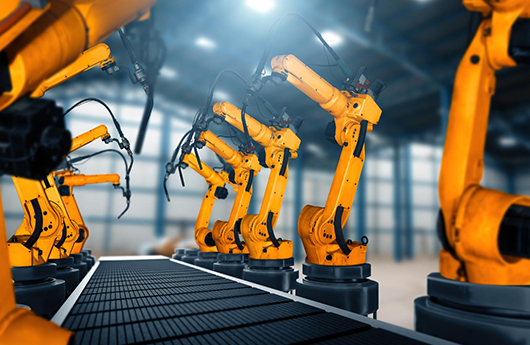
Industrial robots are advanced automation systems that simultaneously provide speed, precision, and continuity on production lines. They have a wide range of applications, from assembly and material handling to palletizing and process support. The mechanical and motion transmission components used in these systems directly determine the robot's performance and operational reliability.
In industrial robot applications, gearboxes ensure the controlled and stable transmission of high torque, while spindle motors form the basis of precise and repeatable movement. Vacuum pumps contribute to the secure operation of end effectors, especially in handling, gripping, and pick & place operations. The correct integration of these components shortens cycle times and increases the accuracy rate of robotic systems.
Selecting the right equipment—considering the robot’s payload, operating speed, number of axes, and task type—enhances energy efficiency, reduces wear, and ensures system longevity. Conversely, incorrect matching can lead to issues such as vibration, positioning errors, and unplanned downtime.
The goal in industrial robotic systems is not just to provide automation, but to create a continuous, balanced, and predictable production flow. Properly selected and compatible mechanical solutions form the very foundation of this goal.
 Industrial robots are advanced automation systems that simultaneously provide speed, precision, and continuity on production lines. They have a wide range of applications, from assembly and material handling to palletizing and process support. The mechanical and motion transmission components used in these systems directly determine the robot's performance and operational reliability.
 TR
TR